


Types of Leather
Leather and substitute leather products have characteristics that may be viewed as positives or negatives depending upon one's perspective. We have attempted to clarify the terms and attributes below to help you choose the product that best serves your individual needs. Once you have identified the material of your liking, you can add that term to our search bar above to view our product offerings. Learn about carbon fiber and other metals used for nickel free products once you are a leather expert!

Full Grain Leather
|
Cost: |
$$$$ |
|
Durability: |
Rated highest in durability and strength |
|
Characteristics: |
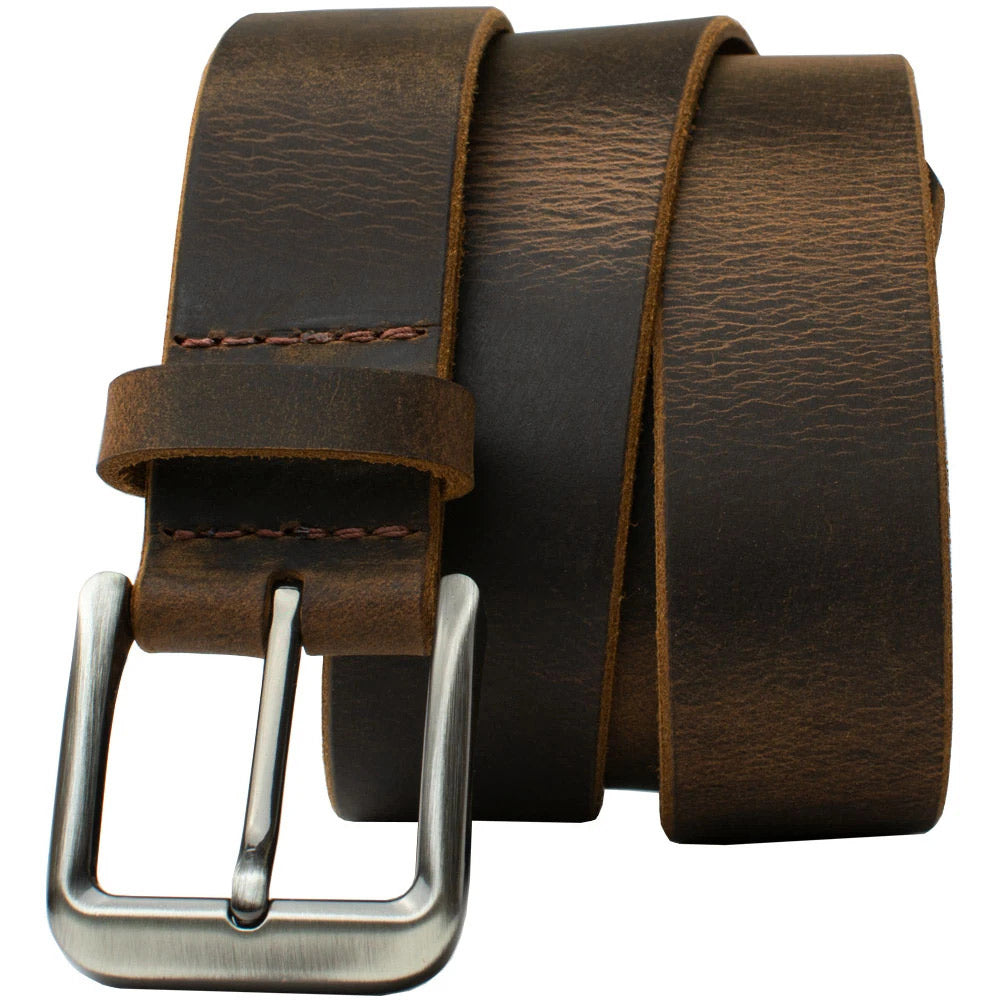
The Roan Mountain Distressed Belt is an example of a full grain leather belt. |
Top Grain Leather
|
Cost: |
$$$ |
|
Durability: |
Rated very high in durability and strength |
|
Characteristics: |
The Black Balsam Knob Belt uses top grain leather for the strap. |
Bridle Leather
|
Cost: |
$$$$ |
|
Durability: |
Rated very high in durability and strength |
|
Characteristics: |
AJ's Gun Belt is made with bridle leather. |
Mid-Grade Leather
|
Cost: |
$$ |
|
Durability: |
Medium durability and strength |
|
Characteristics: |
|
Split Grain Leather
|
Cost: |
$ |
|
Durability: |
Lower durability and strength |
|
Characteristics: |
|
Manmade (Polyurethane)
|
Cost: |
$ |
|
Durability: |
Lower durability and strength |
|
Characteristics: |
|
Bonded Leather
|
Cost: |
$ |
|
Durability: |
Very low durability and strength |
|
Characteristics: |
NoNickel.com does not carry bonded leather products. |
Other Terms of Interest
Genuine Leather
The term "genuine leather" can be used to describe any material made with 10% animal leather. It is widely used to describe leather products but has little value as to quality. Genuine leather has become a generic term with little value, similar to the term “hypoallergenic”.
Tanning
The tanning process converts animal hides into apparel-ready leather by curing, softening, and breaking in the raw leather. Depending on the desired finish, a hide may also be waxed, rolled, lubricated, injected with oil, split, shaved or dyed.
Care Instructions
Cleaning most leather products is easily done with saddle soap. Touch-ups for scuffs can also be accomplished with waxes or shoe polishes. Testing on an inconspicuous spot is always recommended! Cleaning or polishing is not recommended for full grain leather.
Copyright © 2003-2026 Athena Allergy Inc. All rights reserved

